
“Blood will out.” Shakespeare
How to write about blood loss and shock:
Authors should understand the effects of blood loss on the body. Acute blood loss is called hemorrhage.
The state of shock from blood loss is called hypovolemic shock or hemorrhagic shock.
Hypovolemic shock can also happen with severe dehydration, severe diarrhea/vomiting, high fever, diaphoresis (severe sweating often seen with heart attacks), kidney disease and diuretic (“water pills” medications, or fluid getting pigeonholed in a section of the body due to pancreatitis or gut blockage.
There are also FOUR other types of shock. Signs and symptoms may overlap with hypovolemic shock, but the treatment is different.
- anaphylaxis due to allergic reaction
- septic shock due to overwhelming bacterial infection (Note: Viruses do not cause sepsis)
- neurogenic shock from a severe head injury
- cardiogenic shock from an insult to the heart such as a heart attack
Let’s talk about BLOOD:
Blood is unique. A liquid, it has properties other liquids don’t have, like clotting. Blood not only has the red blood cells needed to carry oxygen, nearly 45% of it is made up of solids — platelets for clotting, white blood cells to fight infection and foreign invaders like bacteria, and red blood cells for oxygen to the lungs.
Serum makes up the rest at 55%. Serum carries the proteins, mineral salts, hormones, and glucose (sugar) needed by the cells.
I recently picked up a historical YA detective novel by a new author, co-published by a VERY famous author. On the first page, the main POV character describes an autopsy taking place in the late 1800’s.He notes how much blood comes out of the cadaver, because it had been three days. That was the first mistake.
OOPS, Novel Malpractice!
The character then states had the body been fresh, the floor and table area would be “covered” in blood.
Novel Malpractice Mistake #2.
How to Write About Blood Loss and Shock Share on X
A fresh corpse might ooze a little, or gravity may drain blood out of a wound or open blood vessel, but at autopsy three days later, a corpse would not bleed like this character described.
Recently, I saw the VFA, VERY famous author, interviewed on TV. He confessed he often didn’t do the research he should. Ahem. I would have to agree!

How to write about Shock and Trauma:
Shock, trauma, and blood loss go hand in hand. Per the National Trauma Institute, the #1 cause of death for Americans between the ages of 1 and 46 is trauma. The cost of this is enormous – estimated to be $670 billion a year.
Beyond trauma, common NON-traumatic causes for severe hemorrhage include:
- Surgery
- Aneurysm in the body — aneurysms (a ballooning in an artery) can be in the brain or on any major artery, including the aorta
- Aortic tear (What Sen. Lindsay Graham died from)
- Ectopic (tubal) pregnancy
- Obstetric – placenta abruption (placenta tears away from the wall of uterus, seen with car wrecks and trauma) OR placenta previa – the placenta obstructs the uterus either fully or partially and can bleed, especially when labor starts.
- Gastrointestinal – upper GI bleeding from stomach or duodenal ulcer, lower GI bleeding from the rectum or colon
- Ruptured ovarian cyst
- Post-partum bleeding – believe me, this bleeding can be impressive, fast, and hard to stop. You can deliver the baby, hand it off, and turn around to find the mom bleeding like mad. Women can lose a couple of units of blood in minutes. It is life-threatening.
- Inherited or acquired bleeding disorders – hemophilia A being the most well-known genetic bleeding disease. Excellent resource here: https://www.ncbi.nlm.nih.gov/books/NBK541050/

Things that can LOOK like a lot of blood lost,
but usually don’t result in life-threatening blood loss:
NOSEBLEEDS
HEMORRHOIDS
MISCARRIAGES
MENSTRUATION
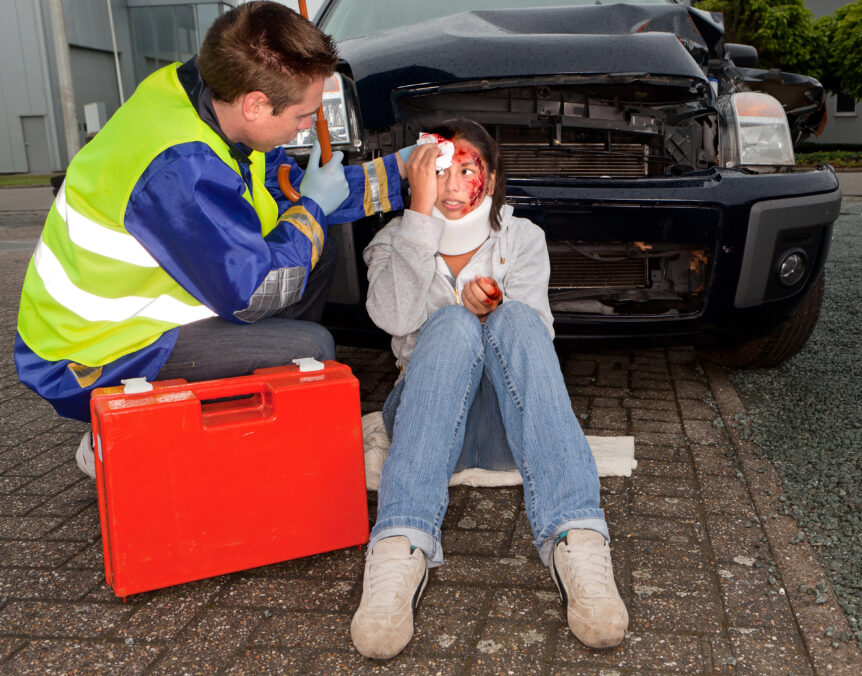
Minor FACE and SCALP WOUNDS
VICTIM FACTORS:
Things to consider for your characters when writing about blood loss and hemorrhagic shock:
- Are they on a blood thinner? This obviously increases bleeding. Multiple medications can be used to thin blood – pay attention to whether they’re pills given by mouth, a shot (subcutaneous) or IV (intravenous). Some drugs such as warfarin can be “reversed” with Vitamin K. Heparin and newer drugs require other drugs to reverse their effects. This entire arena has become complex in the last few years.
- Used to be we had aspirin, heparin IV in the hospital, and switch to warfarin (Coumadin) pills as an outpatient.
- Newer anticoagulants: apixaban, Jantoven, Eliquis, Xarelto, Plavix, Predaxa, Brilinta, and Lovenox. Enoxaparin, Arixtra, Fondaparinux, Fragmin, Argatroban, Prasugel.
- Age? Elderly can be more frail and less responsive to treatment for shock. Children may respond better but are also more susceptible to shock from blood loss – their blood volume is not as large. Babies especially can’t lose much blood.
- Weather/body temperature — It seems it would be the opposite, but cold weather/hypothermia INCREASES blood loss. Platelets and clotting factors work best in a warm body.
- Do they have a bleeding disorder? It goes without saying that hemophiliacs will bleed far more than normal.
The biggest complaint about blood loss depictions in film and TV?
Cops, ER doctors, paramedics, soldiers and other emergency responders often point out how filmmakers and writers show blood loss wrong. They either use way too much and coat the room, or more often, show/describe too little blood… Share on X
-
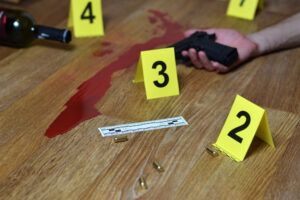
- An average adult has about 1.3 gallons/11 pints/5 liters of blood. In a total bleed-out, there will be a significant amount of blood near the victim if they were shot or beaten or knifed.
- Blood volume varies by size and weight of the individual.
- With injury to a large blood vessel, particularly arteries, or a vascular organ (liver, spleen), fatal hemorrhage can lead to death within 3-6 minutes. Your character might be a superhero, but if a regular human it’s rare that they can run, function and continue to fight.
- Aortic tears (called dissection) can cause almost instantaneous death in 40% of patients. Any tear of what are called the “great vessels” in the body will likely prove fatal without immediate treatment. Princess Diana was found to have a torn pulmonary vein at surgery; they attempted to fix it but she had already lost a massive amount of blood.
- Great explanation here: https://www.uchicagomedicine.org/forefront/heart-and-vascular-articles/silent-killer-everything-you-need-to-know-about-aortic-dissection
#1 Question from Authors:
How much blood can you lose and still live?
How much blood can my hero lose before passing out? How much blood loss is fatal?
The answer changes depending on your individual character. In general, men have more blood volume on average than women. Children, especially babies, have far less.
Blood is expressed as a volume since it’s a liquid, but it’s easier to use a percentage of blood lost. The doctor or nurse or paramedic can just say “they lost half of their blood.”
That way you’re not left trying to figure out your villain’s weight, height and calculate their predicted blood volume in order to state how many pints or gallons were lost. Unless this is a vampire novel . . . and they need to know their daily intake!
First symptoms occur at around 14-15% blood loss. The person may feel dizzy, lightheaded, and/or a little sweaty. (Think blood donation – why they make you lie down and drink juice afterwards)
Patients with other illnesses (co-morbidities), children, and the elderly may experience symptoms sooner or expire faster before hitting the 50% blood loss mark.
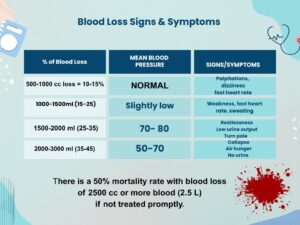
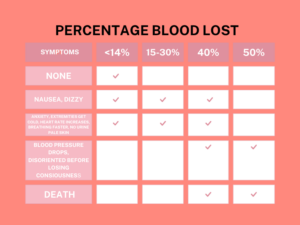
FOR BLOOD LOSS WITH NOTHING ELSE GOING ON (like a heart attack) FIFTY PERCENT BLOOD LOSS IS FATAL. Novel Malpractice by Ronda Wells MD Share on X
How to Write About Hypovolemic Shock:
This occurs when a victim has lost 20% or more of their total blood volume. Symptoms worsen as more blood is lost. Once a victim reaches the point of losing consciousness, this signals insufficient blood is going to the brain.
Death is likely within two hours if shock isn’t treated; death still occurs at a high rate even when treated. The following symptoms are what a character could experience:
- Rapid, shallow breathing and high pulse/heart rate (this response is muted among the elderly, whose heart muscle doesn’t respond to the body’s catecholamines like epinephrine. Diagnosis can be delayed here by mistake.)
- Confusion
- Sweaty, moist skin; clammy skin
- Anxiety – feeling uneasy, fearful
- Confusion, wooziness
- Weakness or fatigue
- Drowsy (start of losing consciousness)
- Urine output drops or stops completely
- Unconsciousness, followed by coma
Once blood loss reaches 40%, the body can no longer compensate. Blood pressure drops, and the heart fails. Share on X
Another common question from authors when writing about blood loss:
How much blood will my character lose with a fracture/broken bone?
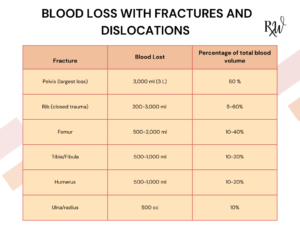
Blood loss by Fracture Type
Remember: Match your character’s wounds with the correct expected blood loss. Scalp wounds bleed impressively, but they won’t cause death.
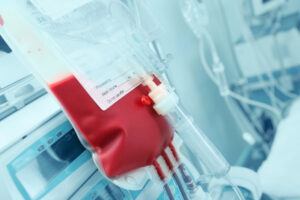
The best treatment for blood loss and shock from blood loss is always: BLOOD!
IV Fluids and other products can help but don’t correct all the problems.
Deeper Dives:
https://pmc.ncbi.nlm.nih.gov/articles/PMC10207757/pdf/13049_2023_Article_1088.pdf This article is free, and has an outstanding anatomic diagram of common sites for bleeding with trauma. There’s also a treatment algorithm.
https://www.ncbi.nlm.nih.gov/books/NBK430734/