


How to write about Dissociative Amnesia
AND GET IT RIGHT.
WHO AM I? WHO ARE YOU?
Really– who am I? This is the question asked repeatedly by a person suffering from Dissociative Amnesia. It’s distressing to say the least.
Who are you? Is the other question they ask over and over, because they may have no memories of their entire life. (Same as someone with dementia.)
Amnesia disorders overlap between the fields of psychiatry and neurology, but are classified as psychiatric disorders. While amnesia is most intriguing to write about (like an actor, the character becomes another person) dissociative amnesia is likely the hardest to create an authentic, accurate fictional portrayal.
In fact, amnesia in general, especially dissociative (formerly called psychogenic or functional), has been used repeatedly in fiction, film and television shows.
Unfortunately, it’s almost always depicted wrong.
Dissociative amnesia is an unusual retrograde amnesia that develops from major physical trauma, severe emotional trauma, or exposure to awful events such as war. These patients often have a history of childhood trauma, traumatic brain injury such as concussions, and/or other psychiatric disorders such as depression.
Dissociative amnesia that can’t be attributed to physical reasons (called neurogenic or organic amnesias.) can be caused by:
- head injury (concussion and/or coma)
- neurosurgery
- seizure
- stroke
- brain infection
This amnesia overlaps with other psychiatric issues such as PTSD, Post-Traumatic Stress Disorder, Dissociative Fugue, and Dissociative Identity Disorder.
My advice for writing about dissociative amnesia may surprise you: Don’t use it. It’s quite rare, and genuine fugue state is even rarer. from Novel Malpractice Share on X
While Dr. Jekyll is an easily likable, identifiable character — how many of us want to encounter, or much less become, a Mr. Hyde?
The rarest of the amnesia syndromes, dissociation is a term that means a separation of mind from reality.
FIRST: Learn how the brain works to store memories:
Only recently has it been discovered how memories are stored and accessed. When I was in med school, they knew certain brain areas were important for memory and recall — especially after the disastrous introduction of frontal lobotomy for all kinds of mental illnesses in the 1930’s.
But as more sophisticated testing developed, especially functional MRI (fMRI) and PET scans, the idea that one area of the brain had a singular function began to be disproved. In fact, the human brain is highly sophisticated. Researchers were shocked when doing epilepsy surgeries to find multiple areas lit up when a patient was asked to think of a bird.
It wasn’t a single neuron storing a memory, like a bit in a computer (either on or off). Memories were stored in multiple areas of the brain!
“Mirror” neurons were discovered in the early 1990s in monkey studies. As a monkey performed a task, another monkey watched — and the pattern of neurons lit up in both their brains was the same. Empathy for another’s plight may depend on mirror neurons, as we imagine ourselves in the same scenario.
People with autism spectrum disorder may well have defects in mirror neurons, which is why they struggle to understand emotions.
Here’s the kicker: further research showed mirror neurons could be retrained, so again, the brain’s plasticity (ability to change, remodel or relearn) is amazing.
As writers, we may well be stimulating a mirror neuron response in our readers, which is why getting emotion onto the page is crucial. Novel Malpractice by Ronda Wells MD. Share on X
The latest thing to come out on memory storage is even more intriguing. Memories are composed of smell, taste, seeing, hearing, touch — all the things we should have our characters experience–but they may well be locked behind a key controlling neuron.
To access that memory, one has to have the code, so to speak. If not, that memory is locked and inaccessible. This could well explain amnesia from traumatic events, especially in childhood. And poses interesting questions for dementia research as well.
The brain will act to protect against emotional harm. Dissociation isn't always abnormal. Novel Malpractice Share on X
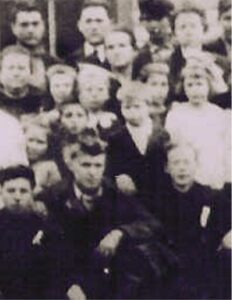
At the age of seven, my mother suffered a traumatic event in Appalachian Kentucky that caused her to develop a neurosis – claustrophobia. Not until I was a physician with kids of my own did my dad tell me what had happened. Mom’s brain had clearly locked that terrible violent event away. When she was put in a similar situation though, surrounded by darkness in a closed space, the memories of that physical, sexual, and emotional harm threatened to break through.
Mom is the little girl to the right, in a white dress and a bow in her hair. The man in the middle of the front row is my grandfather, severely disabled by rheumatoid arthritis. The villain of Mom’s life is in the other part of this photo, which contains nearly a hundred of my ancestors and relatives.
How do you write about dissociative amnesia?
Everyone likely knows this character or a real life story of someone found after many years. A person disappears, then turns up decades later living someplace else, under a different name, with a completely different identify.
One of the most famous cases was author Agatha Christie, who was missing for eleven days.
When a character dissociates, they have an uncontrolled loss of touch with their surroundings, other people, and awareness of self, body, and senses. It occurs as a protective mechanism during a tragic event, and can go away immediately. (Why someone can recall the gun during a mugging but not the perpetrator’s face.) If that amnesia becomes more permanent, then it becomes dissociative amnesia.
If you do decide to write about Dissociative Amnesia, before you start, I’d suggest reading this great article by neuropsychologist Sallie Baxendale: “Memories aren’t made of this: amnesia at the movies.” BMJ 2004;329:1480 https://www.bmj.com/content/329/7480/1480
Ms. Baxendale points out that the film Memento does an accurate job of showing someone with severe anterograde amnesia. And surprise! Dory in Finding Nemo is also correct. A recent K-Drama (Our Sticky Love) surprised me by also getting it right. A prosecutor who is nearly beaten to death wakes up with total memory loss and a man claiming to be her boyfriend.
What traumas can trigger Dissociative Amnesia?
- Abuse (sexual, emotional, or physical)
- Combat/war
- Natural disasters
- Accidents
- Torture/kidnapping
- Overly-developed feelings of shame
- Extreme daily stressors such as bullying at school or work
What variety of symptoms does a person with Dissociative Amnesia have?
Dissociative amnesia can lead to a full loss of personal identity. The person cannot recall who they are nor remember any biographical details. (think Jason Bourne in The Bourne Identity, which may have been inspired by the genuine cases of Ansel Bourne in 1887) Learned skills may be retained, or sometimes they’re lost. The patient may have a total change in personality, or not.
In the K-Drama, the prosecutor remained the same basic city “girl-personality” at first — “I know I would NEVER be with a boxer or violent person!” Recalling her memories was vital though, because she had evidence in a high-profile case to take down the mayor and a big industry for fraud. She could spout legal precedents, but couldn’t recall she’d been a prosecutor nor her name.
Currently, Dissociative Amnesia is divided into four categories:
- Localized Amnesia: The most common form – is the failure to remember things that happened during a set period of time.
- Selective Amnesia: The person can remember some but not all the events of a certain set period of time, or for a traumatic event. My mom for instance only recalled fragments of her childhood around that time, plus she lost both parents in quick succession.
- Generalized: More extensive, but the rarest form. Person forgets their entire life’s history. Obviously this form is the most troublesome for the patient because it destroys their identity, functioning — and they may not realize like the K-Drama prosecutor that their prior life has put them in danger from some very bad people!
- Systematized: Loss of memories around certain events, or people, or circumstances tied to highly emotional events.
Let’s talk about fugue! In amnesia, not Bach.
The most severe type of dissociative amnesia, fugue sufferers have near-total loss of memories for their entire life. Their identity, basic world facts, and even events such as marriage or the birth of a child are lost. Fugue state usually doesn’t last long. It takes about three to six months to recover, and nearly all memories return, but some details may be lost.
Fugue is also called conversion disorder or somatic symptom disorder.
Symptoms of fugue state can include: confusion, inability to recognize people they know, emotions seem detached, failure to attend work, family events or other appointments, or even aimless wandering.
One unique characteristic is that fugue sufferers wander or travel.
The DSM IV defines fugue as:
- sudden, unexpected travel away from home or one’s customary place of work, with inability to recall one’s past
- confusion about personal identity, or the assumption of a new identity
- significant distress or impairment
The trauma here isn’t physical — it’s emotional, although they could have a history of abuse.
You can see how this disorder overlaps with dementia, which can appear to be the same. Fugue means “flight,” and many patients disappear overnight, establish a new life elsewhere, and then return all of a sudden, back to normal decades later.
NOTE! Events during the fugue state are not recalled after the fugue ends. So your character won’t remember meeting that new fellow during the fugue state.
This particular diagnosis is debated among psychiatric experts because of the issue of possible malingering – not knowing if the person is faking the memory loss or not. Especially if they’re fleeing criminal charges!
A GREAT resource on the medical definitions needed to make the diagnosis of dissociative amnesia is here:
https://www.psychdb.com/dissociative-disorders/amnesia
A wonderful list of diagnostic tests needed can be found here: https://doi.org/10.36518/2689-0216.1298
A very detailed but interesting look at memory: https://pmc.ncbi.nlm.nih.gov/articles/PMC4061789/